How Data Sync Works
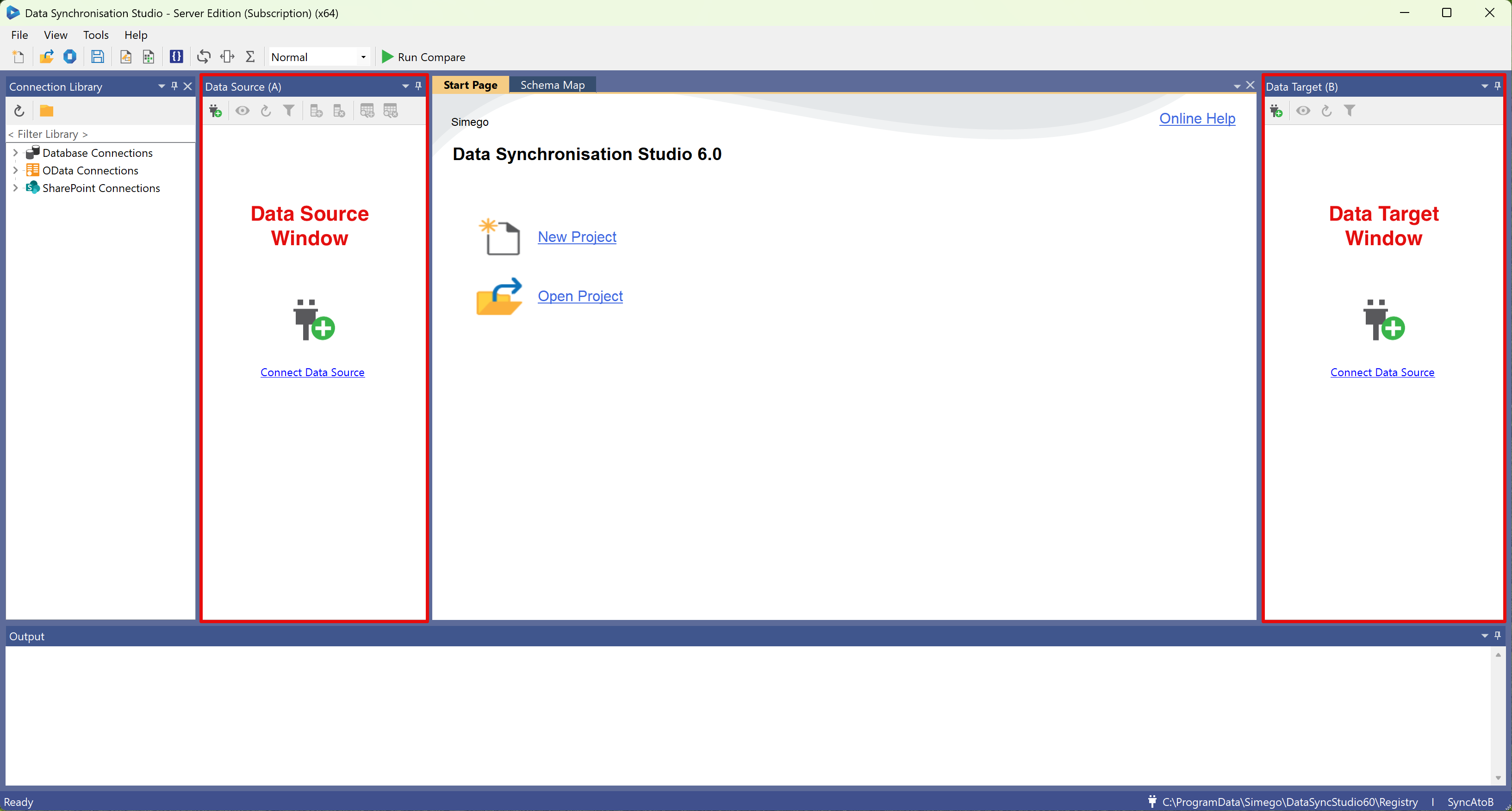
Every Data Sync project follows the same basic workflow: connect two data sources (your source and target), map the fields between them, compare the data to identify what's changed, then synchronise those changes.
This page walks through each stage so you know what to expect before building your first project.
1. Connect your Data Sources
When you open a project you'll see two data source windows — Source (A) on the left and Target (B) on the right. Connect each one to your data and the schema will load automatically, showing the available columns from each system.
2. Map the Fields
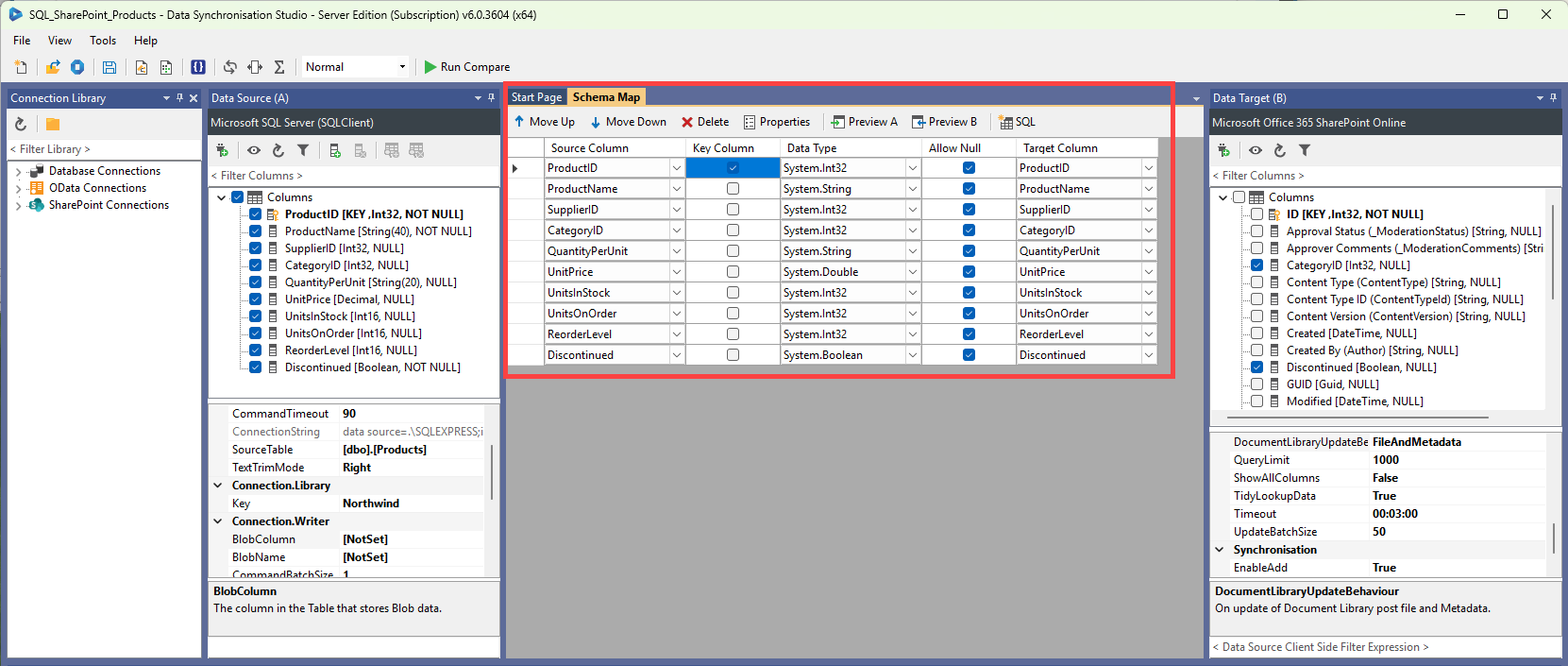
The Schema Map in the centre defines which column in the source maps to which column in the target. Data Sync will create a default mapping based on matching column names, but you can adjust this to suit your data.
The most important thing to set is the Key Column — this is how Data Sync identifies whether a record already exists in the target. It should be the column that uniquely identifies each row, typically an ID field.
Data Sync uses the key column to determine what kind of operation each record needs:
- ADD — the key value exists in the source but not the target. This is a new record that needs creating.
- UPDATE — the key value exists in both source and target, but one or more field values differ.
- DELETE — the key value exists in the target but not the source. This record no longer exists in the source.
3. Compare
Press the Run Compare button on the toolbar to run the comparison. Data Sync reads both data sources and works out what changes would be needed to make the target match the source.
No data is changed at this point — it's a read-only operation you can run as many times as you like.

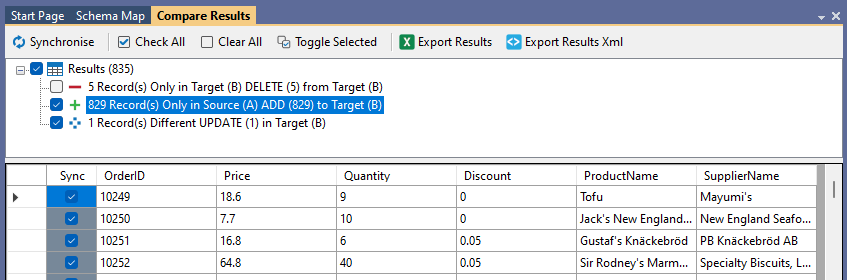
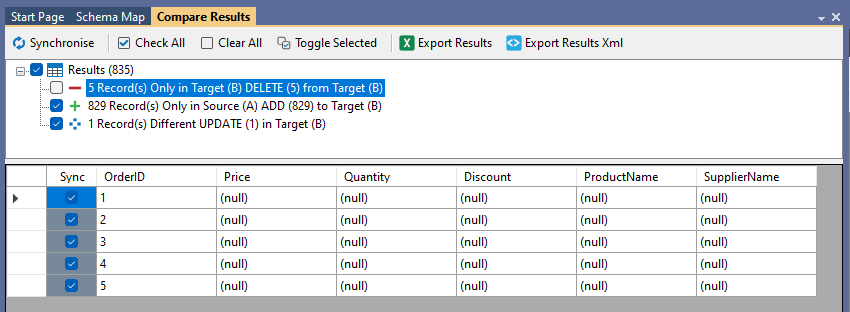
The results window opens and organises changes into three tabs — ADD, UPDATE, and DELETE — so you can review exactly what will happen before committing to anything.
Add
The ADD tab shows records that exist in the source but not yet in the target. Each row represents a new record that would be created.
Update
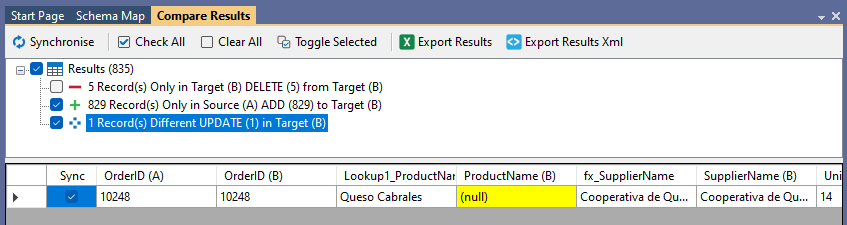
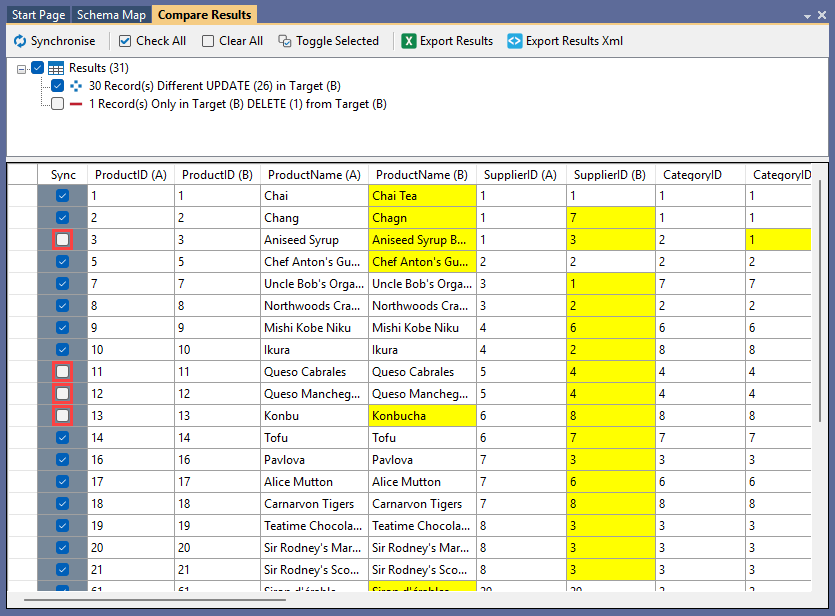
The UPDATE tab shows records that exist in both systems but where the data has changed.
The target row shows the current value in the target (highlighted in yellow) alongside the new value from the source, making it easy to verify the changes look correct before committing.
Delete
The DELETE tab shows records that exist in the target but no longer exist in the source — records that would be removed from the target.
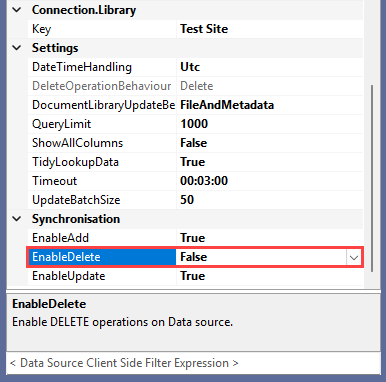
Deletes are disabled by default. You need to explicitly enable them by setting the EnableDelete property to True in the target datasource properties. This is a deliberate safeguard to prevent accidental data loss.
Choosing What To Sync
You don't have to sync everything the comparison finds. Data Sync has a few ways of excluding items in the comparison results from the synchronisation.
Select Rows
When you click onto the specific results tabs, each row has a Sync checkbox — uncheck any rows you want to exclude from the current run. This is useful when you want to apply most changes but hold back specific records to review further.
Disable or Exclude Adds/Updates/Deletes
You can also disable entire operation types (function) either by setting it project wide, or for the single synchronisation.
To disable a function project wide, go to the target property settings and set EnableAdd, EnableUpdate, or EnableDelete to False. This will still show you the results for that function in the compare results but those changes will be excluded from the sync.
To exclude a function for a specific synchronisation you can simply uncheck the checkbox next to the corresponding result (e.g. ADD, UPDATE, DELETE) in the comparison window.

Note that if a function is disabled in the target properties, including in the compare results will not include it in the synchronisation. I.E. If EnableDelete is set to False, checking the checkbox in the comparison results window will not include it in the synchronisation. This is to ensure no accidental changes can happen.
Export Compare Results
You can also export the compare results before syncing using the export option in the toolbar — either as an Excel file or XML file. This is handy for sharing a proposed change set with someone else for sign-off, or keeping a record of what was identified at a point in time.

4. Synchronise
Once you're happy with the changes, press the Synchronise button in the results toolbar to apply them to the target.
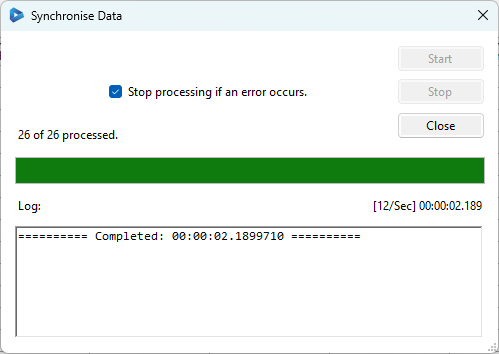
The sync window shows the number of records being processed and a log output section that updates as the sync runs. When complete the log will show the total time taken. You'll be able to see the number of records processed above the green bar.
If an error occurs on a row, the details will be displayed in the log. By default the sync will stop on the first error, but you can change this behaviour in the window to continue running even if individual rows fail — useful if you expect a small number of problem records and don't want them to block the rest of the sync.
The window has Start, Stop, and Close buttons. Stop is only available once the sync has begun, and Close lets you dismiss the window once the run is complete.
5. Verify
Once the synchronisation has completed you can verify everything ran as expected by pressing Run Compare button again. If the sync was successful, the records that were previously shown as ADD, UPDATE, or DELETE (if enabled) should no longer appear in the results — Data Sync will show zero changes because the source and target are now in sync.
If you excluded any rows from the synchronisation by unchecking them in the compare results, those records will still appear in the results when you re-run the compare. This is expected — they were intentionally skipped and will continue to show until they are synced.
If there are still unexpected changes showing after the sync, this could indicate that some records failed to apply — check the sync log for any errors. Or one of the actions may have been disabled, for example deletes are disabled by default so records will not be deleted unless this is enabled.